

Tree Root Damage to Sewer Lines: A Broomfield Homeowner's Guide
Tree root damage to sewer lines is one of the most common — and costly — plumbing problems for Broomfield homeowners. This guide covers warning signs, repair vs. replace options, typical costs, and what your insurance may cover. If you've got cottonwoods or willows in your yard, your sewer line may already be at risk. Schedule a sewer inspection in Broomfield
Introduction
You notice the toilet draining slowly. Then the basement floor drain backs up. By the time you call a plumber, the camera shows a web of roots inside your main sewer line.
Tree root damage to sewer lines is a serious problem — and it doesn't fix itself. Broomfield's mature tree canopy is part of what makes this area a great place to live. But those same trees can quietly destroy underground pipes over months or years.
This guide explains exactly how tree root damage to sewer lines happens, how to spot it early, and what your repair options are — including what Broomfield homeowners typically pay. We'll cover warning signs, removal and repair methods, average costs, insurance coverage questions, and how to find a qualified plumber in Broomfield for a sewer camera inspection.
What Should You Do If You Have Tree Root Damage to Your Sewer Line?
If you have tree root damage to your sewer line, take these steps:
Watch for signs — slow drains, gurgling toilets, sewage smells, or recurring backups.
Get a camera inspection — a licensed plumber uses a sewer camera to confirm root intrusion.
Choose a removal method — hydro jetting or mechanical cutting clears roots; severe damage may need pipe lining or full replacement.
Check your insurance — most standard policies exclude sewer lines, but a sewer backup rider may help.
Act fast — roots grow quickly and can cause complete pipe collapse if left untreated.
Not sure if roots are your problem? We can check. Book a sewer camera inspection in Broomfield
Tree Root Removal and Sewer Repair Options
Once we confirm root intrusion, you have several options. The right one depends on how much damage exists, the age and material of your pipe, and how close the tree is to the line.
| Repair Method | Permanence | Best For |
|---|---|---|
| Mechanical cutting (augering) | Temporary | Minor intrusion; buys time |
| Hydro jetting | Longer-lasting | Clearing roots and buildup together |
| CIPP pipe lining | Long-term | Cracked pipes without collapse |
| Pipe bursting | Long-term | Full replacement, minimal digging |
| Traditional excavation | Long-term | Collapsed or severely damaged sections |
Mechanical cutting (augering) uses a rotating blade to cut roots out of the pipe. It works quickly but doesn't seal the cracks the roots used to enter the line. Because those openings remain, roots typically grow back within one to three years.
Hydro jetting sends high-pressure water through the sewer line, cutting roots and flushing out grease, sludge, and debris at the same time. It's more thorough than augering and leaves the pipe cleaner, which slows root regrowth.
CIPP pipe lining is a trenchless repair method. A resin-saturated liner is inserted into the damaged pipe and cured in place, forming a new pipe inside the old one. This seals cracks from the inside and creates a smooth surface that roots cannot easily penetrate — without digging up your yard.
Pipe bursting is a trenchless full replacement technique. A new pipe is pulled through the existing line while the old pipe fractures outward. This works well when the original pipe is too damaged to be lined but excavation should be minimized.
Traditional excavation is necessary when a sewer pipe has fully collapsed or when trenchless methods aren't practical. While it involves digging, it can sometimes be the most reliable long-term solution.
How Tree Roots Get Into Sewer Lines
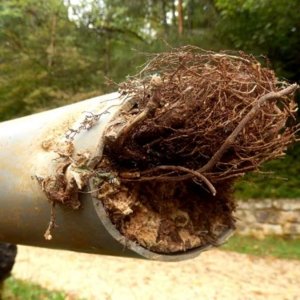
Roots don't break through solid pipe — they find the weak spots. Small cracks, aging joints, and loose fittings let moisture escape into the surrounding soil. Roots follow that moisture trail and work their way inside.
Once a root enters a pipe, it grows. What starts as a thin tendril can become a dense mass that restricts flow and eventually breaks the pipe wall entirely. The process is slow, but the damage it causes is not.
Pipe material matters. Older clay and Orangeburg pipes are far more vulnerable than modern PVC. Clay joints can shift and crack with soil movement. Orangeburg — a pressed fiber pipe used through the mid-1900s — softens and collapses over time. PVC has fewer joints and resists intrusion better, but it's not immune.
Front Range trees known for aggressive root systems include:
Cottonwood
Willow
Silver maple
Lombardy poplar
In our experience inspecting homes throughout Broomfield, cottonwood roots show up most often near main sewer lines. We frequently find them clustered at pipe joints within 10–20 feet of the tree's trunk — often on lines that were never a problem until the tree matured.
How Much Does Tree Root Sewer Line Repair Cost in Broomfield?
Cost depends on how far the damage has progressed and what method is needed to fix it. Here are general ranges to help you plan:
| Service | Typical Range |
|---|---|
| Sewer camera inspection | $150 – $350 |
| Hydro jetting | $350 – $600 |
| CIPP pipe lining | $80 – $250 per linear foot |
| Pipe bursting (full replacement) | $60 – $200 per linear foot |
| Traditional excavation & replacement | $3,000 – $25,000+ depending on depth and length |
Note: Ranges are based on national cost data from Angi and HomeAdvisor along with regional contractor benchmarks. Actual pricing varies depending on the condition of the line and the complexity of the repair.
What drives cost up or down:
Depth of the pipe plays a major role. Sewer lines buried deeper underground require more excavation work, specialized equipment, and additional labor to reach safely.
Pipe material also affects the repair method. Older clay sewer lines are more fragile and harder to reline compared to newer PVC systems.
Linear footage matters because most trenchless repairs are priced per foot. The longer the damaged section of pipe, the higher the final cost.
Access conditions can also increase the price. Sewer lines located under concrete slabs, driveways, or heavily landscaped yards take longer to reach and repair.
Broomfield has clay-heavy soil in several areas, particularly in older neighborhoods near Midway Boulevard and Sheridan Boulevard. Clay soil shifts more than sandy soil, which can place extra stress on aging pipe joints and make excavation slower and more complex.
Based on jobs we've completed in Broomfield, most homeowners dealing with moderate root intrusion spend between $500 and $1,500 for hydro jetting plus a camera inspection. Jobs that require pipe lining or full replacement move into the several-thousand- dollar range.
We provide a clear price before any work begins — no surprise charges.
Warning Signs of Tree Root Damage in Your Sewer Line
Root intrusion rarely announces itself all at once. It builds over time. Here's what to watch for:
Common warning signs:
Slow drains throughout the home — not just one fixture
Gurgling sounds coming from toilets or floor drains
Foul sewer odors inside or outside the home
Recurring backups even after the drain has been snaked
Wet or unusually green patches in the yard above the sewer line
When multiple drains in your home are slow at the same time, that points to a main line problem — not a clog at one fixture.
How plumbers confirm root intrusion: We run a sewer camera — also called a CCTV inspection — through the main line. The camera gives us live footage of exactly what's inside the pipe. We can see root masses, cracks, pipe separation, and buildup. You see the same footage we do. There's no guessing.
We often get calls from Broomfield homeowners who've had the same drain snaked two or three times in a year. Each time, it clears briefly and then backs up again. The root cause — literally — was never addressed. A camera inspection is the only way to know what you're actually dealing with.
Does Homeowners Insurance Cover Tree Root Sewer Damage?
For most homeowners, the answer is no — but the details matter. Insurance coverage often depends on whether the damage is considered gradual, sudden, or related to a sewer backup event.
| Scenario | Typically Covered? |
|---|---|
| Gradual root intrusion over time | No — most standard policies exclude gradual damage |
| Sudden pipe collapse caused by root pressure | Sometimes — depends on policy language |
| Sewage backup into the home | Only with a sewer backup endorsement |
| Damage to belongings from backup | Only with contents coverage + endorsement |
Standard HO-3 homeowner policies usually treat tree root intrusion as gradual damage. Gradual damage is almost always excluded from coverage. If roots slowly infiltrated your sewer pipe over several years, the insurer will likely deny the claim because the issue developed over time rather than from a sudden event.
Sudden or accidental damage can sometimes be treated differently. If a tree root causes a sudden pipe collapse, some policies may cover the resulting damage to your home. However, many policies still exclude the cost of repairing or replacing the pipe itself. Coverage details vary widely, so it's important to review your policy language or speak with your insurance agent.
Sewer backup riders are optional endorsements you can add to your homeowner's insurance policy. These typically cover damage to your home and belongings caused by a sewage backup, but they usually do not cover repairing the pipe that caused the backup. These riders often cost around $40–$100 per year depending on the insurer.
Who owns which part of the sewer line: In Broomfield, homeowners are responsible for the sewer lateral — the pipe that runs from the home to the city's main sewer line. The city maintains the main sewer line itself. Because of this, repairs caused by tree roots in the lateral are almost always the homeowner's responsibility.
If you're unsure where your responsibility ends, check with the City of Broomfield Utilities Department or review your property records to confirm where your lateral connects to the municipal system.
The best step you can take: call your insurance provider to understand your exact coverage, then schedule a sewer camera inspection. A professional inspection provides video footage and a written assessment you can share with your insurer if a claim may apply.
How to Prevent Tree Root Damage to Your Sewer Line
The most affordable sewer repair is the one you avoid. These steps help you stay ahead of root intrusion before it becomes an emergency.
Prevention checklist:
✅ Schedule a sewer camera inspection every 1–2 years if you have mature trees near your sewer line
✅ Use slow-release copper sulfate root treatments in floor drains annually — products like RootX are EPA-registered for drain line use and slow root regrowth without harming the tree
✅ When planting new trees, keep them at least 10 feet from sewer lines — 20+ feet for species with aggressive root systems like cottonwood or willow
✅ Know your pipe age and material — clay pipes over 40–50 years old are past their expected service life and worth inspecting proactively
✅ Address slow drains early — don't wait for a backup to investigate
Sewer line lifespan context: Clay pipes typically last 50–60 years. PVC can last 100 years or more. If your Broomfield home was built before 1980 and still has the original sewer line, a proactive inspection makes sense — regardless of symptoms.
Proactive maintenance vs. emergency repair: A camera inspection runs $150–$350. A hydro jetting treatment runs $350–$600. An emergency sewer repair at midnight — after a backup has flooded your basement — can run several thousand dollars plus water damage cleanup. The math is straightforward.
Keep your sewer line healthy year-round sewer line maintenance in Broomfield
The Drain Cleaning Company 7180 W 117th Ave D, Broomfield, CO 80020 (720) 948-4175 Plumbing License: MP.03000945